
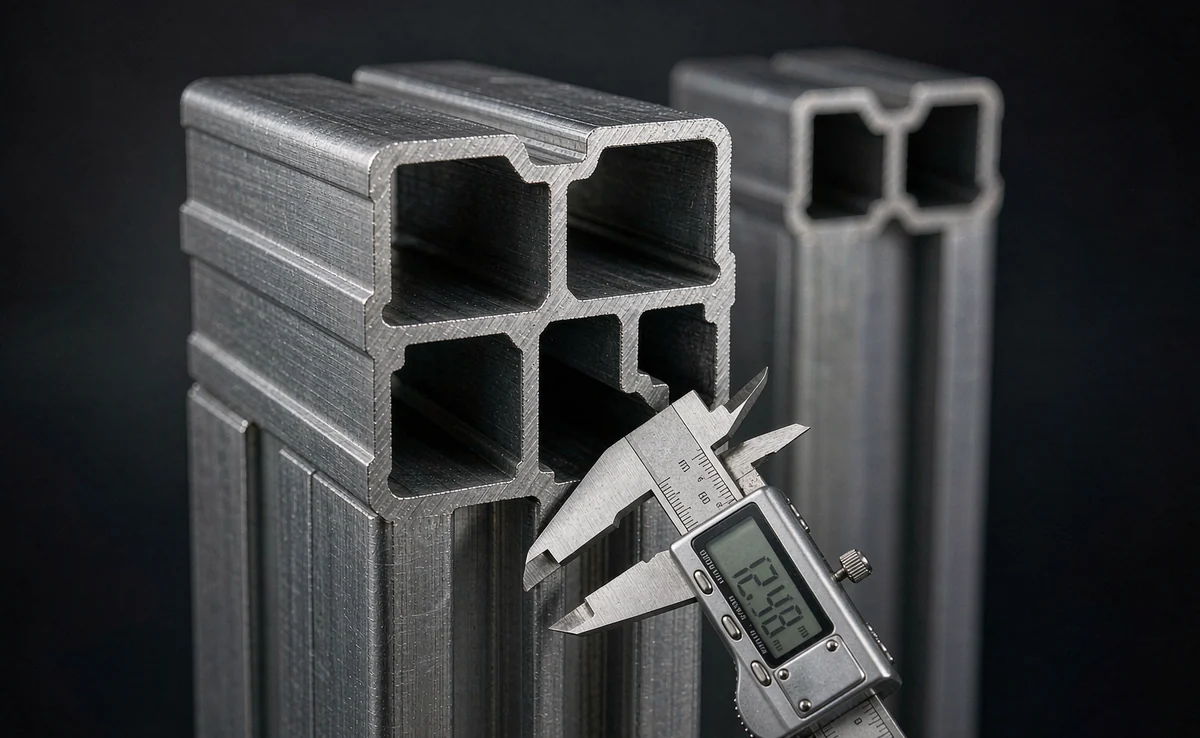
Profile and wall thickness
Wall thickness affects stiffness and screw-holding, which matters at hinges, corner joints and lock positions. A heavier wall is not automatically better for every opening, but it is a real difference in cost and in behaviour on large sashes.
- Wall thickness is stated per series.
- Alloy and temper come from the mill, with certificates on request.
- Thin walls show up first at fixings and corners.
Thermal strips and gaskets
The thermal strip is a structural component of the frame, not a seal. Gaskets are the seals: EPDM resists UV and ozone better than cheaper rubbers, which is why it is used on exposed elevations.
- PA66 GF25 strip, mechanically joined.
- EPDM gaskets at frame and sash rebates.
- Brush seals at sliding interlocks.
Finishes
Powder coating is the standard finish for architectural aluminium. Color, gloss and pretreatment decide how it holds up. On coastal or strongly sunlit sites the pretreatment and the color choice matter more than the brand of powder.
- Pretreatment before coating.
- Color and gloss agreed in writing.
- Dark colors on sunny elevations run hotter.
Hardware materials
Hinges, rollers and lock points carry load and wear. Stainless or coated hardware is specified for humid and coastal sites; the grade should be stated rather than assumed.
- Stainless grade stated for exposed sites.
- Rollers matched to panel weight.
- Lock points at the top, middle and bottom where specified.
Materials and what they decide
| Component | Typical specification | What it decides |
|---|---|---|
| Profile | Aluminium extrusion, stated wall thickness | Stiffness, fixing strength |
| Thermal strip | PA66 GF25 polyamide | Frame heat path |
| Gasket | EPDM | Air and water sealing, UV life |
| Glass | Insulated unit with Low-E option | Most of the thermal performance |
| Hardware | Stainless or coated steel | Operation and corrosion life |
| Finish | Powder coating with pretreatment | Color life and surface durability |