
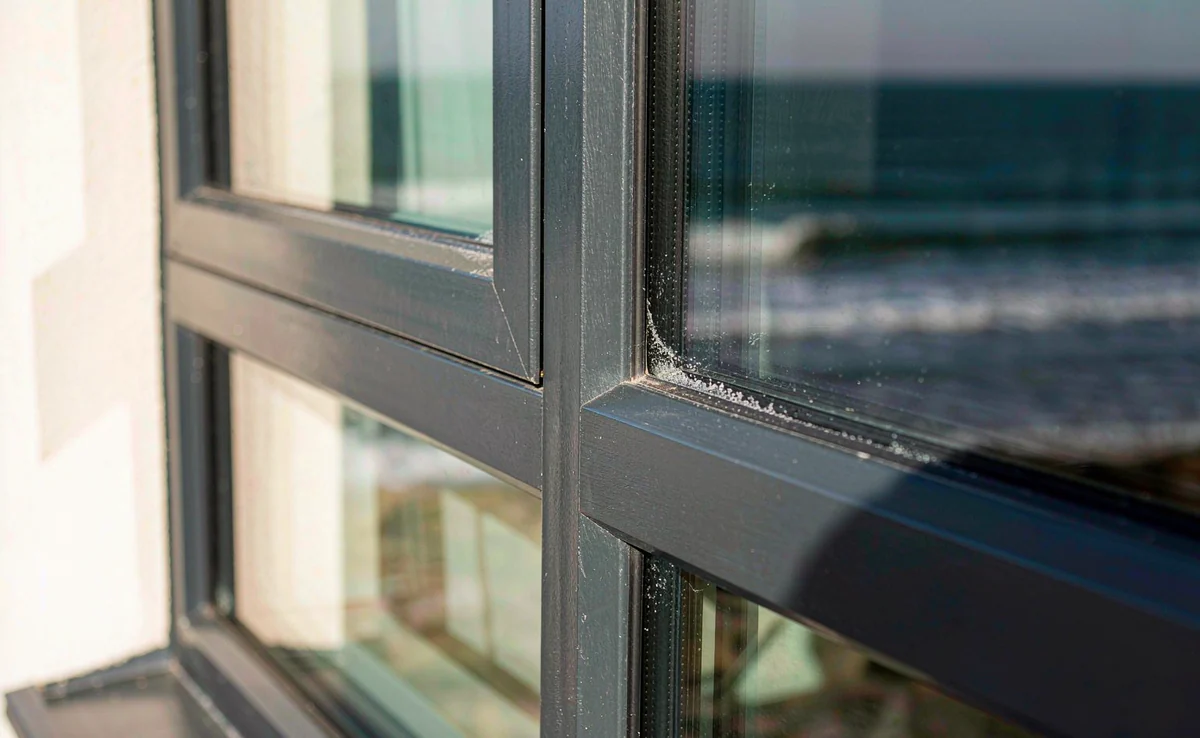
What salt does
Salt deposits hold moisture against the surface and accelerate corrosion at edges, scratches and fixings. The vulnerable points are rarely the flat face of a profile; they are cut ends, screw heads and the gap under a sliding panel.
- Cut ends and machined edges need protection.
- Fixings should be stainless, not coated steel.
- Water must not stand in the track.
Coating and pretreatment
Powder coating performance depends on the pretreatment underneath it. On a coastal site, a multi-stage pretreatment and a coating system suited to the exposure class matter more than the color.
- Pretreatment stage stated by the coater.
- Coating thickness within the specification.
- Touch-up strategy agreed for site damage.
Seals and drainage
EPDM gaskets resist UV and salt better than many alternatives. But a seal only works if water can leave: drainage slots, a stepped track and a clear discharge path are part of the sealing system, not an accessory.
- EPDM in exposed positions.
- Drainage slots kept clear at installation.
- Weep paths that cannot be blocked by the sill detail.
Maintenance that actually helps
A coastal window needs a routine: fresh water rinse, track clearing, gasket inspection and prompt touch-up of scratches. The specification should make that routine possible without dismantling the unit.
- Rinse rather than scrub.
- Clear the track before the season changes.
- Check gaskets at corners, where they shrink first.
Coastal specification checklist
| Item | Specify | Reason |
|---|---|---|
| Coating | Pretreated powder coat suited to exposure | Salt and UV resistance |
| Fixings | Stainless grade stated | Avoid galvanic corrosion |
| Rollers | Stainless axle | Track corrosion |
| Gaskets | EPDM | UV and ozone life |
| Drainage | Slotted sill, clear discharge | Standing water is the main enemy |
| Maintenance | Written routine | Keeps the system working |